Monday, March 5, 2012

Pros And Cons Of A Mild South Florida Winter

By John H. Foy, director, Florida Region
February 29, 2012

In addition to the persistence of moderate to high disease pressure, plant parasitic nematodes are another pest problem being encountered on recent TAS visits in South Florida. Irregular shaped areas of weak, chlorotic turf and no roots are classic symptoms of a nematode problem.   

As noted in the January and February regional updates, we have been enjoying very mild to warm temperatures this winter. This is in stark contrast to the past two winters of prolonged and record setting cold temperatures. On a positive side, the weather has been great for getting out and playing, and during recent TAS visits most courses are reporting that increased rounds are being hosted. It has also been encouraging to hear that as a result of innovative campaigns, a number of clubs have successfully increased membership levels. Furthermore, the very mild to warm temperatures have helped reduce turf damage from carts on courses in the southern half of the state. 
On the other side of the coin, increased pest pressure has been a concern at many courses. As previously reported by Todd Lowe, leaf spot disease problems typically subside in early January with cooler temperatures and lower humidity. Yet, during the mid to latter part of February, warm temperatures in combination with higher humidity levels and overcast conditions resulted in a perfect storm scenario for leaf spot disease and other fungal pathogens. At one point, disease pressure was so high that outbreaks occurred even on putting greens receiving aggressive preventative fungicide treatments.  With the extended weather forecast calling for more of the same, continuing fungicide treatment programs on putting greens is advised. Exercising care with nitrogen fertilization and making sure that sufficient levels of potassium and magnesium are maintained can aid in reducing the susceptibility to leaf spot disease outbreaks.
Another pest problem that is starting to be encountered is plant parasitic nematodes.  With a lack of cold weather, there has not been much of a slow down in activity of these microscopic, worm-like organisms that feed on the root system of the turf. The resulting root system damage greatly impairs the ability to take up nutrients and moisture, and on putting greens this results in irregular shaped areas of chlorotic weak and thin turf coverage. Very shallow and disfigured roots are classic symptoms of elevated nematode population levels, and laboratory assays of soil samples submitted from courses recently visited have confirmed the existence of this pest problem.  Eradication of nematodes or any other pest organism is economically and environmentally impossible. Limitations in available curative nematicide treatments have made it even more difficult to keep nematode population levels suppressed below damaging thresholds. Thus, more so than ever before, employment of agronomically sound and proven basic management practices to produce healthy turf growth and minimize other stress factors to the degree possible is a mandated survival strategy. Space is not available to review all aspects of an integrated nematode survival management program. For more specifics, please do not hesitate to contact Todd Lowe or myself. 
Invoices for the 2012 Turf Advisory Service (TAS) have been mailed to courses in Florida. The cost for a TAS visit is $2400 for a half-day and $3400 for a full-day. Payments made before May 15th result in a $600 discount – rates of $1800 and $2800 respectively. You can call our office, 772-546-2620 to schedule your visits at anytime. We look forward to working with you to discuss disease, nematode, or any other issues regarding golf course maintenance. 

Source:  John Foy, jfoy@usga.org, or 772-546-2620

Friday, August 12, 2011

North and Old West Curfew Recovery

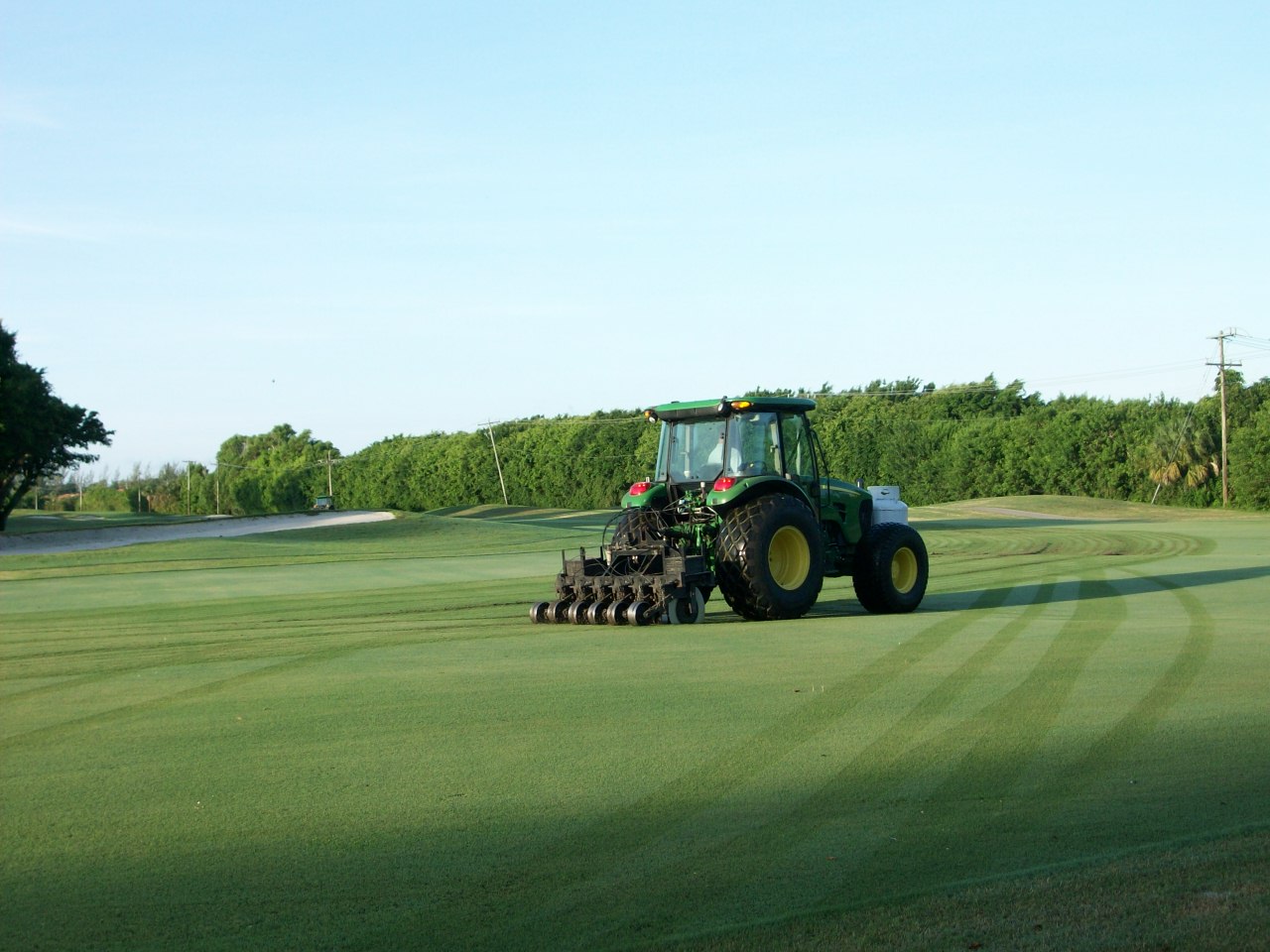
Nearly two weeks following the Curfew application on the fairways of Old West Course (Holes #1 - #5 and #15 - #18)  the slits in the turf have all but healed.   Darker green turf where the injections were made are the only signs remaining from the application.  The areas that were showing stress due to higher nematode populations have begun to recover as well.  

#1 West Fairway

The North Course which was "Curfewed"  last Saturday has also begun to heal with very little turf burn.  This healing was aided by the much needed afternoon showers we have been receiving this week. 

#1 North Fairway

Monday, August 1, 2011

Old West Curfew Application

On Saturday, July 30, 2011, an application of Curfew was made to the tees and fairways on holes 1 - 5 and 15 - 18 of  the West Golf Course.  Curfew is a soil fumigant that is slit injected into the soil as a liquid and volatilizes as a gas within the soil profile to kill target pests.  In this case plant parasitic nematodes and mole crickets present at the time of treatment.   Plant parasitic nematodes are slender round worms that range in size from 1/300 to 1/3 of an inch.  Some species of nematodes feed on healthy plant tissue. Treatment is necessary because even with proper nutrients, water and oxygen, turf quality can decline over time due to nematode damage.   Curfew is applied by trained, licensed professional applicators using specialized equipment.  Because of the nature of Curfew,  you cannot reenter the treated area until 24 hours after the treatment is completed.   Full turf recovery from the Curfew application should be seen a few weeks after application.  Expect quickest and greatest improvement to be on poor quality turf.  Be advised we will be applying Curfew on the North Golf Course tees and fairways on Saturday, August 6, 2011.


Wednesday, July 20, 2011

Intermediate Rough Cut

After a brief test run on the South Course, we have decided to add an intermediate rough cut to the West Course and North Course over the next few weeks.  The feedback from members has been very positive.  As the cut matures the definition between the fairway and intermediate cut  and the intermediate cut and rough cut will become more pronounced.

Tuesday, July 19, 2011

12 West Waste Area

During the current West Course closure the golf maintenance department is installing a waste area between #12 West Green and #13 West Tee.  The waste area will be very similar to the one located to the right of #14 South Green installed last summer.  The primary reason for installing the waste area was to remove the cart path that had severely deteriorated over the years. However, the added benefit is a waste area that is easier to hit from than pine needles and requires less overall maintenance.  Additional photos will be posted once completed.


Friday, July 15, 2011

West Course Greens - Verticutting


The above is a short video demonstrating some of the verticutting we perform on the putting greens during the summer closures.  Verticutting helps remove excess leaf tissue, thatch and surface organic matter.  The process promotes a smoother and firmer putting surface.

Wednesday, June 29, 2011

New Practice Putting Green

Five weeks after planting,  the new practice putting green is growing in quite well.  The Champion bermudagrass sprigs have really taken to the recent rainfall and have covered about 75% of the putting surface.   We have begun mowing the green once a week at a height of 0.200".  Once the surface is completely covered with grass, we will then take steps to ensure smooth ball roll prior to opening.  As it stands now, we are on schedule to open the green Labor Day week.  Again, thank you for your patience.