Tuesday, June 26, 2012

Driving Range Regrassing

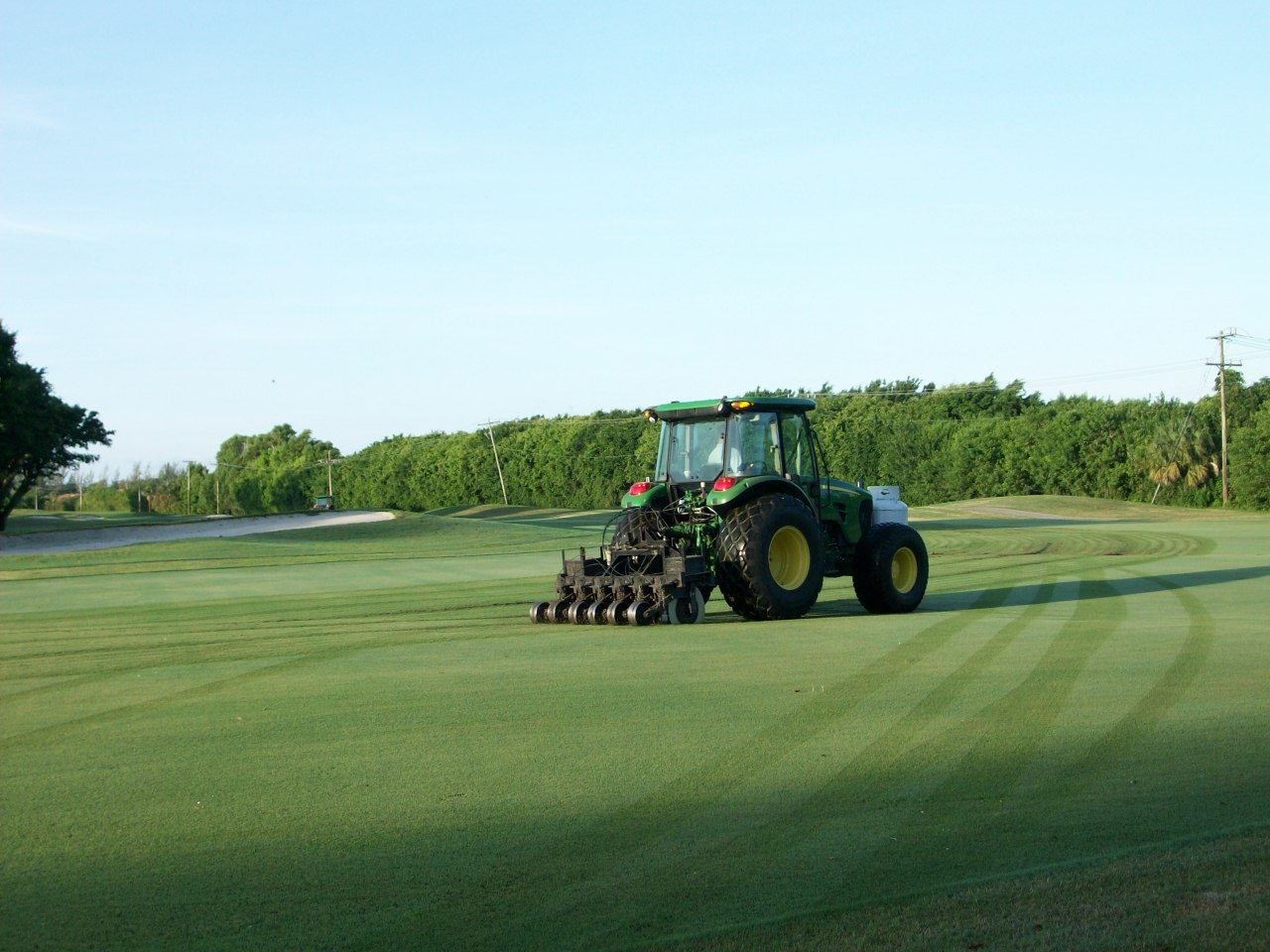
Following the herbicide treatment to the upper practice tee on the east side of the practice range, Briggs Golf Course Construction arrived Tuesday to strip the existing turf from the practice tee.  Over the next two days, they will continue to remove the turf and haul it away.
                                                
Following the removal of the turf, the surface will be roto-tilled and rough graded.  A soil fumigant will be applied and watered through the profile through the weekend to ensure proper eradication of the existing turf.   Weather permitting, the tee will be finish graded and laser leveled early next week.  Once the tee is leveled, large rolls of Celebration sod will be laid on the new practice tee surface.

Celebration bermuda grass offers excellent color and playability.  Celebration’s aggressive growth rate allows for quicker recovery and healing from divots and provides better wear tolerance than traditional bermuda grasses. 

Because of Celebration’s aggressive growth rate, cultural practices and mowing will begin approximately one week following installation.  Providing cooperation from the weather, the tee should be open for use by the beginning of August.

Saturated Conditions


After suffering through a second straight year of drought conditions in South Florida, the rainy season has arrived early and in full force.  Since the first of May we have received an excess of 30 inches of rain.  In May alone we accumulated more than 20 inches of rain at the Fountains CC.  Now with the arrival of hurricane season we are seeing no reprieve from the wet weather.  Coupled with the effects of Tropical Storm Debbie, 8 inches of rain was recorded last week. 
 

#7 South Fairway
The excessive amounts of rainfall have caused the already shallow water table to continue to rise.  Water levels in the lakes are currently about a foot over their banks and have even caused some cart paths to become submerged and impassable.  The benefit is all of the lakes on the property are now full, however the ground has become so saturated there is no where for the extreme amounts of standing water to go.  At this point we are dumping water off property to assist in drainage, yet there are areas of the courses that drain slower and will remain wet for extended periods of time due to the waterlogged conditions.

Please understand we are doing everything at this time to ensure that the golf courses remain playable, but with abnormally heavy rains it has become difficult.  It seems every time we dry out we get more rain.  Be careful what you wish for. 


Tuesday, June 5, 2012

The Future of Golf

Thank you to the Fountains CC for donating a tee sign, as well as a foursome of golf for the 32nd Annual Palm Beach Golf Course Superintendent's Association Future of Golf Tournament at The Falls CC! Proceeds go to turfgrass research, student scholarships, and junior golf.

South Course Summer Closure

Today was the South Course was closed for summer cultural practices.  As previous with the North Course; the greens will be verticut in eight directions to a depth of 1/16", mowed, aerified with 1/2" hollow tines on a 2"x2" spacing, swept clean, topdressed, and brushed.  The tees, collars and approaches will receive the same treatment a week later.  The fairways are being aerified with 3/4" hollow tines on 3"x3" spacing with our new John Deere Aerocore 2000 and John Deere 5550 tractor. During this time the rough is also being aerified with or pull behind spoon aerifier.  Aerification is necessary to reduces compaction caused by equipment, golf cart, and foot traffic.  It also improves overall water infiltration and gas exchange.  The South Course will be closed from June 5 - July 1.  At that time we will continue the same practices on the West Course.

Tuesday, April 3, 2012

Recent Greening May Be Short-lived


By Todd Lowe, senior agronomist, Florida Region
March 14, 2012

Cottony mycelium from Pythium was recently seen on South Florida putting greens.

Recent visits have seen a vibrant shade of green on many golf courses. Mild temperatures experienced this past winter have kept soil temperatures higher and turf has remained actively growing in South Florida. Temperature patterns continue to trend upwards and as a result the turf is resuming active growth from Orlando south. Semi-dormant roughs that were tan to dull green from lower soil temperatures are now green, especially on courses that have recently applied fertilizers.
Plant pathogens and disease occurrences have been discussed on recent visits. Moderate temperatures coupled with high relative humidity have encouraged diseases. Leaf spot disease continues to plague golf courses, as well as several recent Pythium outbreaks. Diligent scouting is necessary for effective disease management so that fungicides can be applied in a timely manner. The dry season in our region generally occurs from March thru May, and this should help reduce disease activity throughout our region.
While the dry season will improve disease management, it also will increase localized dry spots and cause some discoloration on tees, fairways and roughs. This temporary loss of color has no long-term effects on turf health and can be improved through increased irrigation or hand watering. Preventative wetting agent treatments are recommended over the next several months to reduce localized dry spots and improve turf quality. Prolonged dry conditions may cause water management districts to impose water restrictions. Hopefully, this will be kept to a minimum this year, so that long-term turf deterioration from drought stress does not occur.
Mole cricket tunneling has been observed on several golf courses, but these are overwintered adults that are beginning to forage. Large-scale insecticide programs are applied in late spring/early summer to catch the mole cricket egg hatch and provide season-long control. Overwintered adults can be managed with less expensive “chase and spray” programs. Some superintendents even apply low concentrations of dishwashing liquid (1 teaspoon of dishwashing soap per gallon of water) to flush and kill isolated groups of overwintered adult mole crickets.
The Florida Region USGA Green Section will be hosting three Course Official meetings next month in Naples, Palm Beach and Tampa. We hope you can attend one of these informative workshops to learn about some of the common issues faced throughout the year. Topics will include putting green maintenance programs, trees, bunkers, recent changes in the Rules of Golf as well as a Question and Answer session for attendees to discuss any golf course related topic. Registration information will be emailed at the end of the week. For more information, call Shelly Foy, 772-546-2620. 
Source:  Todd Lowe, tlowe@usga.org or 941-828-2625 

Thursday, March 8, 2012

...interiors are extra!


Not only does the Golf Course Maintenance staff try to give our members and their guests the best possible golf course conditions on a daily basis, we also try to give a little extra when it comes to our Member/Guest events at the Fountains Country Club.  In conjunction with the fanatastic presentation of food and flair offered in the clubhouse during yesterday's event, each paricipant's car was washed while they were out on the course.  We hope these added touches leave our members and their guests with lasting memories of their great day at the Fountains.

Wednesday, March 7, 2012

An Abnormally Dry Winter

Although a significant rain event occurred in early February 2012, the positive effects of the much needed rain has diminished and again left us in the beginning stages of drought.  With temperatures for February higher than normal and constant tropical winds, the golf courses are drying out at a faster than normal rate.  The irrigation systems struggle to maintain adequate soil moisture conducive to growing quality turf grass suitable for golf.   Since November 1, 2011 only 5.56 inches of recorded rain has fallen across the area.  That is well below the 13.81 inches normally received.

 For example, the Fountains Country Club is currently permitted to use 25.2 million gallons of water for irrigation purposes on the golf courses for February 2012.  If the normal 2.55 inches of rainfall for the month of February occurs the permitted amount is generally adequate for irrigation.  Evan though, to this point in February, we have received 0.4 inches of rainfall more than normal, we began the year in a huge deficit and have been unable to gain any ground.  In addition all of the February rainfall occurred over the course of a few days early in the month.  As a result of these shortages, many localized dry areas have become visible on the golf courses, especially on the North and “Old West 9.”  These dry spots occur where irrigation coverage is inadequate and where soils are extremely sandy and have limited water retention.  To combat these dry spots, additional water and wetting agents are applied in efforts to combat turf decline.

To this point, the effects of the limited rainfall are only evident on the courses with the older irrigation system. However if these dry conditions continue, a repeat of the drought of 2011 could be inevitable and some turf loss may occur.

Shannon Wheeler
Director of Greens and Grounds
Fountains Country Club

Monday, March 5, 2012

Pros And Cons Of A Mild South Florida Winter

By John H. Foy, director, Florida Region
February 29, 2012

In addition to the persistence of moderate to high disease pressure, plant parasitic nematodes are another pest problem being encountered on recent TAS visits in South Florida. Irregular shaped areas of weak, chlorotic turf and no roots are classic symptoms of a nematode problem.   

As noted in the January and February regional updates, we have been enjoying very mild to warm temperatures this winter. This is in stark contrast to the past two winters of prolonged and record setting cold temperatures. On a positive side, the weather has been great for getting out and playing, and during recent TAS visits most courses are reporting that increased rounds are being hosted. It has also been encouraging to hear that as a result of innovative campaigns, a number of clubs have successfully increased membership levels. Furthermore, the very mild to warm temperatures have helped reduce turf damage from carts on courses in the southern half of the state. 
On the other side of the coin, increased pest pressure has been a concern at many courses. As previously reported by Todd Lowe, leaf spot disease problems typically subside in early January with cooler temperatures and lower humidity. Yet, during the mid to latter part of February, warm temperatures in combination with higher humidity levels and overcast conditions resulted in a perfect storm scenario for leaf spot disease and other fungal pathogens. At one point, disease pressure was so high that outbreaks occurred even on putting greens receiving aggressive preventative fungicide treatments.  With the extended weather forecast calling for more of the same, continuing fungicide treatment programs on putting greens is advised. Exercising care with nitrogen fertilization and making sure that sufficient levels of potassium and magnesium are maintained can aid in reducing the susceptibility to leaf spot disease outbreaks.
Another pest problem that is starting to be encountered is plant parasitic nematodes.  With a lack of cold weather, there has not been much of a slow down in activity of these microscopic, worm-like organisms that feed on the root system of the turf. The resulting root system damage greatly impairs the ability to take up nutrients and moisture, and on putting greens this results in irregular shaped areas of chlorotic weak and thin turf coverage. Very shallow and disfigured roots are classic symptoms of elevated nematode population levels, and laboratory assays of soil samples submitted from courses recently visited have confirmed the existence of this pest problem.  Eradication of nematodes or any other pest organism is economically and environmentally impossible. Limitations in available curative nematicide treatments have made it even more difficult to keep nematode population levels suppressed below damaging thresholds. Thus, more so than ever before, employment of agronomically sound and proven basic management practices to produce healthy turf growth and minimize other stress factors to the degree possible is a mandated survival strategy. Space is not available to review all aspects of an integrated nematode survival management program. For more specifics, please do not hesitate to contact Todd Lowe or myself. 
Invoices for the 2012 Turf Advisory Service (TAS) have been mailed to courses in Florida. The cost for a TAS visit is $2400 for a half-day and $3400 for a full-day. Payments made before May 15th result in a $600 discount – rates of $1800 and $2800 respectively. You can call our office, 772-546-2620 to schedule your visits at anytime. We look forward to working with you to discuss disease, nematode, or any other issues regarding golf course maintenance. 

Source:  John Foy, jfoy@usga.org, or 772-546-2620

Friday, August 12, 2011

North and Old West Curfew Recovery

Nearly two weeks following the Curfew application on the fairways of Old West Course (Holes #1 - #5 and #15 - #18)  the slits in the turf have all but healed.   Darker green turf where the injections were made are the only signs remaining from the application.  The areas that were showing stress due to higher nematode populations have begun to recover as well.  

#1 West Fairway

The North Course which was "Curfewed"  last Saturday has also begun to heal with very little turf burn.  This healing was aided by the much needed afternoon showers we have been receiving this week. 

#1 North Fairway

Monday, August 1, 2011

Old West Curfew Application

On Saturday, July 30, 2011, an application of Curfew was made to the tees and fairways on holes 1 - 5 and 15 - 18 of  the West Golf Course.  Curfew is a soil fumigant that is slit injected into the soil as a liquid and volatilizes as a gas within the soil profile to kill target pests.  In this case plant parasitic nematodes and mole crickets present at the time of treatment.   Plant parasitic nematodes are slender round worms that range in size from 1/300 to 1/3 of an inch.  Some species of nematodes feed on healthy plant tissue. Treatment is necessary because even with proper nutrients, water and oxygen, turf quality can decline over time due to nematode damage.   Curfew is applied by trained, licensed professional applicators using specialized equipment.  Because of the nature of Curfew,  you cannot reenter the treated area until 24 hours after the treatment is completed.   Full turf recovery from the Curfew application should be seen a few weeks after application.  Expect quickest and greatest improvement to be on poor quality turf.  Be advised we will be applying Curfew on the North Golf Course tees and fairways on Saturday, August 6, 2011.


Wednesday, July 20, 2011

Intermediate Rough Cut

After a brief test run on the South Course, we have decided to add an intermediate rough cut to the West Course and North Course over the next few weeks.  The feedback from members has been very positive.  As the cut matures the definition between the fairway and intermediate cut  and the intermediate cut and rough cut will become more pronounced.

Tuesday, July 19, 2011

12 West Waste Area

During the current West Course closure the golf maintenance department is installing a waste area between #12 West Green and #13 West Tee.  The waste area will be very similar to the one located to the right of #14 South Green installed last summer.  The primary reason for installing the waste area was to remove the cart path that had severely deteriorated over the years. However, the added benefit is a waste area that is easier to hit from than pine needles and requires less overall maintenance.  Additional photos will be posted once completed.


Friday, July 15, 2011

West Course Greens - Verticutting


The above is a short video demonstrating some of the verticutting we perform on the putting greens during the summer closures.  Verticutting helps remove excess leaf tissue, thatch and surface organic matter.  The process promotes a smoother and firmer putting surface.

Wednesday, June 29, 2011

New Practice Putting Green

Five weeks after planting,  the new practice putting green is growing in quite well.  The Champion bermudagrass sprigs have really taken to the recent rainfall and have covered about 75% of the putting surface.   We have begun mowing the green once a week at a height of 0.200".  Once the surface is completely covered with grass, we will then take steps to ensure smooth ball roll prior to opening.  As it stands now, we are on schedule to open the green Labor Day week.  Again, thank you for your patience.

Wednesday, June 22, 2011

Mole Cricket Treatment

Mole Cricket Nymph
On Tuesday, June 21, an application of Chipco Choice was made to the fairways on the South golf course and the fairways of the West golf course south of the L-14 canal.  Chipco Choice is applied by slit injecting the insecticide directly into the soil.  This method ensures better efficacy of the insecticide at lower rates of application.  Thus allowing play to resume on the treated areas of the golf course immediately after application.  The primary target pest is the mole cricket, however, multiple ant species are controlled by the Choice as well. The mole cricket damages turfgrass by burrowing in the soil and feeding on roots.  The feeding weakens the turfgrass plant and the tunneling disrupts the playing surfaces.  Application timing is very important, as it is best to apply the insecticide when mole crickets are young and easier to control.  Some slits in the surface may be visible on the fairways following the application but will disappear after a couple of mowings.


Chipco Choice Applicator

Fairway Following Chipco Choice Application


Monday, June 20, 2011

Rough Maintenance

As we enter the summer months, one of the concerns of our golfers is the height of the rough cut.  During the winter months we maintain the rough at 2" in an effort to maintain good definition between the rough and fairway cut.  During the summer closures we "scalp" the rough down to 1" effective height of cut in efforts to expose the turf canopy to better sunlight infiltration and to promote new growth.   By doing this, the turf comes back healthier and denser.  Thus, reducing the chances for the golf ball to nestle down in the rough.  We understand that the temporary conditions may not be visually pleasing, however, this will lead to better playing conditions in the future. 

Thursday, June 16, 2011

South Course Fairway Aerification


With the fairways generally being around ten times the area of a the putting greens on the golf courses we would use a tractor mounted pull behind fairway aerifier.  However, with one unavailable to suit our needs, we set out to aerify the fairways on the South Course with the same walk behind aerifiers that we use on the greens and tees.  One machine can aerify one acre in 80 minutes.  The South Course has 26 acres of fairways, which constitutes roughly 35 man hours.  The benefits of using the walk behind aerifiers over our current fairways pull behind aerifier, is more of the surface area is disrupted allowing for better water infiltration, reduced compaction, and better air penetration into the soil.  It also provides topdressing to help control thatch.  All leading to better playing surfaces for our golfers in the future.

Wednesday, June 15, 2011

New Tee Markers

Today our new tee markers are being put out on the West golf course.  The new markers are highly visible and are engraved with the updated Fountains CC logo.  The new tee markers are made of a solid resin much like that of a billiard ball and are virtually indestructible.

Wednesday, June 8, 2011

South Course Closure

June 6, marked the first day of our first South Course closure for summer cultural practices.  Our first item of business was to verticut the south greens very aggressively.  We verticut the greens to a depth of 1/16" and proceeded to verticut up and back on the same pass in four different directions.  This process removed a substantial amount of thatch as well as older leaf tissue.  We then mowed the greens in a circular pattern to remove more leaf tissue.  Later that afternoon a heavy topdressing of sand was preformed in preparation for aerification the following day.


On Tuesday, June 7, the South greens were aerified with 5/8" diameter tines on 2" x 2" spacing.  This will ensure adequate removal of thatch for our first South course closure.  This process also improves water infiltration, improves gas exchange for the plant and a reduces compaction.   The plugs from the aerification were then drug in and then the remaining thatch was blown off the putting surface.


Wednesday, September 29, 2010

The Fountains CC Golf Course Maintenance Blog

Members and Guests,

Now that I have had few weeks to settle in and get acquainted with The Fountains, I will periodically be updating this blog to give you a better understanding of what we do here at The Fountains in our Golf Course Maintenance Department.  We will focus on cultural practices, routine maintenance, weather, among many other aspects of golf course maintenance.  I hope you find it informative as well as educational!

Regards,

Shannon Wheeler
Director of Greens and Grounds
The Fountains Country Club
Lake Worth, Florida